
Note: This is an overview of artificial intelligence (AI) and its connection to student/professional research assignments, as well as academic libraries. It is not exhaustive and is intended only to provide an introduction.
First, there are two types of AI people encounter. Assistive AI provides a supportive role to users, including AIs such as grammar checkers and smart search tools. Generative AI creates something new (generates) for users and is often associated with asking/answering questions in an interactive manner.
Generative AI has sparked numerous controversies, particularly regarding its use in producing new information. The accuracy, intellectual property rights, and ethical and legal uses of generative AI products are often debated. Faculty and students must carefully consider their use of artificial intelligence and be mindful of any potential ethical, legal, or academic code violations. For academic purposes, it is particularly important to consider Southern Arkansas University’s AI policies, including, but not limited to, the university’s Code of Ethics, Academic Integrity Policy, and any guidelines from instructors, supervisors, or accrediting bodies.
While AI is increasingly present in many aspects of life, it has yet to replace the need for human knowledge, skills, and abilities. University students need active learning experiences to help them connect research assignments to real-world performances as professionals (Supiano, 2022). Andragogy connects educational experiences with application outside of the classroom (Knowles et al., 2015). Academic libraries contribute to this educational process by providing resources and services:
- Library and information literacy instruction, including AI (Lo, 2023; Lo, 2024)
- Spaces for social interaction and learning
- Library materials (Oliveira, 2017)
- Particularly for first-generation college students less familiar with library services, spaces, and access/discovery of information (Stocking et al., 2024)
Academic libraries provide resources and services to support students throughout the learning process, often integrating AI education. Students experience research anxiety due to a required academic rigor that often differs from their previous educational experiences (Henderson, 2023). AI makes it easier (at least seemingly) for students and professionals, but more education about AI is needed since it is here to stay. In a recent report on professionals using AI, 84% intend to continue using it (Arroyo-Machado et al., 2025). Some of the topics addressed during the library instruction sessions at SAU include an introduction to information literacy and related skills, targeting:
- SAU’s information literacy standards
- Evaluating resources (including AI outputs)
- Ethically using information
- APA, CMoS, MLA citations and references
- Introduction to AI and SAU’s AI policies
- Searching and using physical library resources
- Searching and using electronic library resources
What is information literacy and AI literacy?
Information literacy is a core component of the educational goals at SAU. Information literacy is a set of skills that professionals use to solve problems and is interwoven with the professional model of evidence-based practice: what we do in practice as professionals is based on high-quality research (Levesque, 2018). Professionals rely on these skills when they are unsure of the answers to problems and when they need to justify their actions. Information literacy and evidence-based practices are often called into action when professionals use and evaluate AI outputs. Information literacy encompasses AI literacy, meaning that AI literacy is a special set of information literacy competencies. The Association for College and Research Libraries has established AI literacy guidelines and recognizes the importance of academic libraries’ roles in educating and providing resources to support the responsible use of AI.
Disadvantages of AI Uses
When students and professionals utilize AI, they must consider its advantages and disadvantages. AI has many uses, disuses (when left unchecked and causing adverse effects), and misuses (when deliberately used inappropriately), and usually needs evaluation and fact-checking (Cordona et al., 2023; Kozuh & Caka, 2023; Shin, 2022; Tomassi et al., 2024). AI outputs or results might be:
- Hallucinated (it makes up fake information)
- Biased (guides to a certain perspective and often overlooks others)
- Misleading (often incomplete in its report or research)
- Unverified sources (often pulling information from unknown or unvetted resources)
- Privacy/security of data (your and others’ information given to or taken from the AI may no longer be private or secure)
- +many other professional/industry standards (Hwang, et al., 2023; Tiernan et al., 2023; Wang et al., 20231)
Many are concerned about hallucinations since these instances are when the AI makes up false information. Biases and misleading information in AI outputs are sometimes difficult to detect, so it is a good idea to compare information with verified resources. Even when an AI provides citations and references for the resources it uses, be aware that these may sometimes be incorrect or fabricated. It is essential to verify that the resources actually exist and accurately reflect the interpretations provided by the AI and forms of social media (Kožuh & Čakš, 2023). Privacy and security issues include the AI taking information provided by the user. Whether it is information entered manually or copied and pasted into AI, the data usually becomes part of many AI platforms, which can cause problems when working with non-disclosure agreements and sensitive data that should not be disclosed. Avoid entering or providing AI information if:
- A non-disclosure agreement is in effect or implied
- The information has property rights (including copyrights like those found in published books, library databases, ebooks, etc.)
- There are privacy laws, ethics, rules, etc. in effect or implied
Considerations of Major Professional Risks of Using AI
Assistive AI:
Assistive AI tends to be less controversial than generative AI. This is often due to the fact that the user must provide input for the AI to assist, such as when using a grammar checker that functions only after the user has provided sentences of a certain type. However, assistive AI, while often helpful, can produce errors. For example, a grammar checker may attempt to correct a user’s statements but misinterpret the tone, usage, and other aspects of what is being said. Assistive AI, such as grammar checkers, may be problematic for students submitting work for originality, as this form of AI is often detectable by AI checkers and raises questions of authenticity and academic integrity.
Generative AI:
AI outputs may unintentionally infringe on the copyrights and other property rights of the data used. Professionals should carefully consider whether the information used is legally defensible and does not violate someone else’s ownership rights. Professionals using AI risk using inaccurate and/or hallucinated information. Professionals using unverified information in professional applications (e.g., reports, medical diagnoses, legal compliance) risk serious damage to their reputation and could lead to major liability. Professionals using AI to analyze proprietary and/or sensitive information can compromise data privacy, as the information provided to the AI is often used to train other models. Professionals using AI may face ethical and legal issues in which authorship and authenticity are questioned by others, including supervisors and other oversight agents.
Advantages of AI Uses
Although AI outputs require review for accuracy, AI can still help researchers and learners in numerous ways. AI has been connected with positive results in inquiry-based learning (Cordona et al., 2023; Hutchinson, 2024; Kim & Lee, 2022; Kong et al., 2024; Maykut et al., 2024; Wang & Chen, 20232). AI has been associated with:
- Helping brainstorm or explore concepts
- Helping identify some key researchers, leaders, related laws/theories, or points on topics
- Helping identify some literature about the topic
- Helping create useful graphics and illustrations
- +more
Considerations of Major Professional Benefits of Using Generative AI
Assistive AI:
Assistive AI can often help users by enhancing their work. Assistive AI can help improve accuracy and consistency. For example, many grammar checkers can help correct errors in subject-verb agreement and spelling errors. Assistive AI often provides diagnostic or quality control checks to target or question possible human errors. Assistive AI can provide improvements in accessibility, such as screen readers and captioning for individuals with disabilities, as well as translation capabilities for those who are not fluent in a particular language.
Generative AI:
As mentioned, professionals using AI benefit from brainstorming and exploring concepts, including testing and prototyping possible solutions, when solving problems. Professionals using AI can often benefit from the speed of analyzing large amounts of content and other data. Professionals using AI can benefit from having an outside perspective that may not be readily available from another human.
| Feature | Generative AI | Assistive AI |
| Output Type | New content (text, image, code) | Suggestions, corrections, analysis, automation |
| Needed Oversight | High – Must be rigorously fact-checked, edited, and ethically/legally reviewed. | Moderate – Requires judgment to verify recommendations and monitor for bias. |
| Primary Risks | Legal/Reputational (Copyrights, Hallucinations) | Operational/Skill-based (Over-reliance, Bias in decision-making) |
AI Prompting (Generative Forms of AI, such as Gemini, Copilot, ChatGPT, etc.)
Many argue about the most effective way to develop AI prompts. Lo (2023, 2024) has led librarians in AI prompt generation with his CLEAR approach. However, many variations have emerged. Many find that the more specific the prompt, the better the results, particularly when they target the following aspects for their research assignments:
- Tell the AI what role you want it to assume (an expert, a novice, a student, etc.).
- Tell the AI what situation or context that it is working, such as student, professional, imaginative, creative, novice, etc.
- Tell the AI what type of work or task you want it to perform.
- Inform the AI of any specific details that need to be considered, such as specific requirements, limits, or tone of wordage.
- Interact with the AI after it produces each response, specifying any changes or other details that need to be included, excluded, etc.
Always review the AI work for errors. This often requires not only verifying that the AI output makes sense but also fact-checking it using verified information from books, journals, research databases, and other credible sources.
Documenting AI
Another aspect of AI is documenting its use. Magale Library provides a Citation Resources library guide to help students with the basics of citations and references in the American Psychological Association (APA), Modern Language Association (MLA), and Chicago Manual of Style (CMoS), including documenting AI. Students may be required to report and provide additional documentation of the use of AI in academic assignments.
Why Academic Libraries in the Age of AI?
Libraries, particularly academic libraries, strive to provide resources in the form of physical and electronic collections, as well as librarians trained as information professionals. Open-access AI tools, such as ChatGPT, Gemini, and Copilot, typically do not have access to resources behind paywalls, including major research databases like EBSCO, ProQuest, JSTOR, and Elsevier.
Research databases provide a wide range of resources, curated by professionals to offer targeted materials that support researchers and related professionals, including scholarly and peer-reviewed content. Copyrights and other property rights are paid through library licenses that provide access to research database content for library patrons; however, this access does not include open-access AI. In response to increasing requests for AI tools, vendors such as EBSCO, ProQuest, JSTOR, Credo, and Britannica Online have developed AI capabilities within their platforms to help users locate and utilize their licensed resources.
What are some policies or considerations for when and how AI may be used?
AI use recommendations and policies vary. SAU enables faculty to make decisions about AI use in their courses and establish their own AI policies. The typical warnings, permits, and bans of AI use mimic many seen in professional settings, including the following three examples.
Example 1: No AI Permitted
 THE USE OF GENERATIVE ARTIFICIAL INTELLIGENCE IS NOT PERMITTED IN THIS COURSE
Using generative AI and related technologies to assist or complete your work in this course is considered an academic integrity violation subject to disciplinary action.
Example 2: Some AI Permitted

THE USE OF GENERATIVE ARTIFICIAL INTELLIGENCE IS PERMITTED IN SPECIFIC COMPONENTS OF THIS COURSE
Students must carefully review the course syllabus and assignment instructions to determine where, when, and how generative AI is allowed. It is the student’s responsibility when permitted to clearly and formally document the use of generative AI when used. Failure to cite the use of generative AI is considered an academic integrity violation and is subject to disciplinary action.
Example 3: AI Is Permitted
 THE USE OF GENERATIVE ARTIFICIAL INTELLIGENCE IS PERMITTED IN THIS COURSE
Generative AI is allowed for use in course assignments. It is the student’s responsibility to clearly and formally document the use of generative AI when used. Failure to cite the use of generative AI is considered an academic integrity violation and is subject to disciplinary action.
Generative AI can be grouped into many categories with some AI platforms capable of more than one output depending on their parameters and users. Below are examples of types of AI:
Types of Generative Artificial Intelligence: Examples
Text Generation, Grammar, and Text Editing |
Coding |

|
|
Image Creation |
Video Generation |

|
 |
Information Generation and Synthesis |
Research |

|
|













What type of AI tools are there in the Library’s database and electronic book collections?
Most of Magale Library’s databases and electronic book collections have artificial intelligence tools to help researchers. These vary from citation/reference tools to help document resources to AI-generated insights and chat tools. All the tools are meant to serve as aids, but, as with most AI, their output needs to be quality-checked. Here are some examples:
Citation Tools
These tools help researchers quickly identify the parts of the resources to aid in referencing the materials, such as author names, titles, publishers, publication dates, etc. These AI tools usually help format the information into formal writing style bibliographic reference entries, such as the Modern Language Association (MLA), American Psychological Association (APA), and Chicago Manual of Style (CMoS). However, as with much AI output, there can be errors, so it is a good idea to double-check the AI’s work.
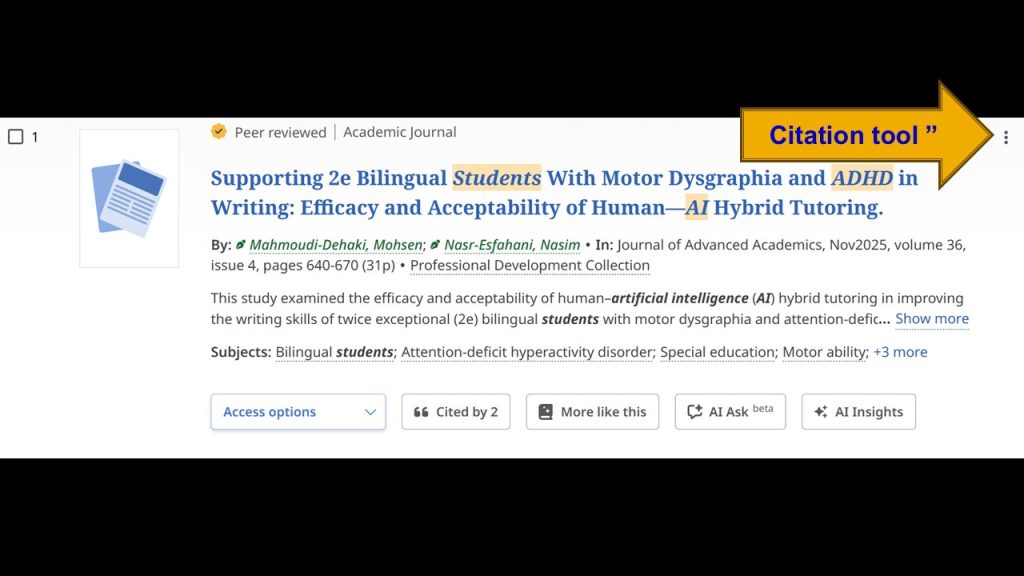
Example Citation tool as found in EBSCO products
AI Insights
These tools can help researchers quickly identify the top takeaways about resources. AI Insights often provide brief bullet points or short summaries of the resource’s key aspects to help users assess its relevance to their needs. However, they are not summative or comprehensive summaries, and inaccuracies may exist, so it is best to use AI insights as a starting point and consult the actual resources.
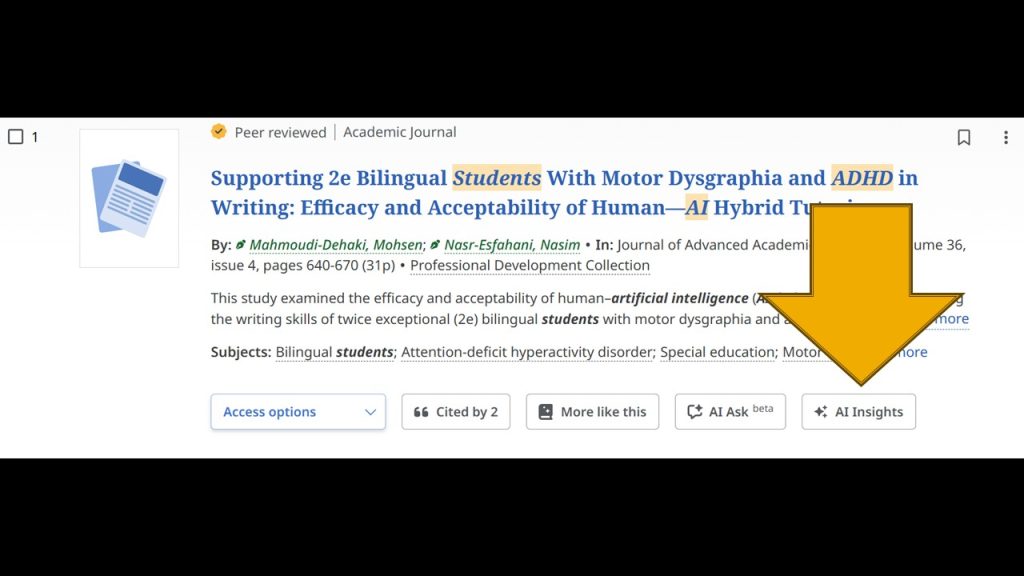
AI Insights tool example as found in EBSCO products
AI Ask or AI Chats
These tools often appear within the database or electronic book collection to assist users in quickly identify relevant parts of the resource for their inquiries. For example, EBSCO’s AI Ask tool (as seen in Magale Library’s Search Electronic Collections tool) often appears after an item has been opened. The AI Ask tool focuses on an open database or ebook item and allows users to ask questions in a chatbox to quickly identify relevant parts of the resource. For example, users may be looking for research studies that specifically use a quantitative methodology, and the AI Ask tool can help the user identify if the method is used in the study and were to locate this particular aspect in the resource.
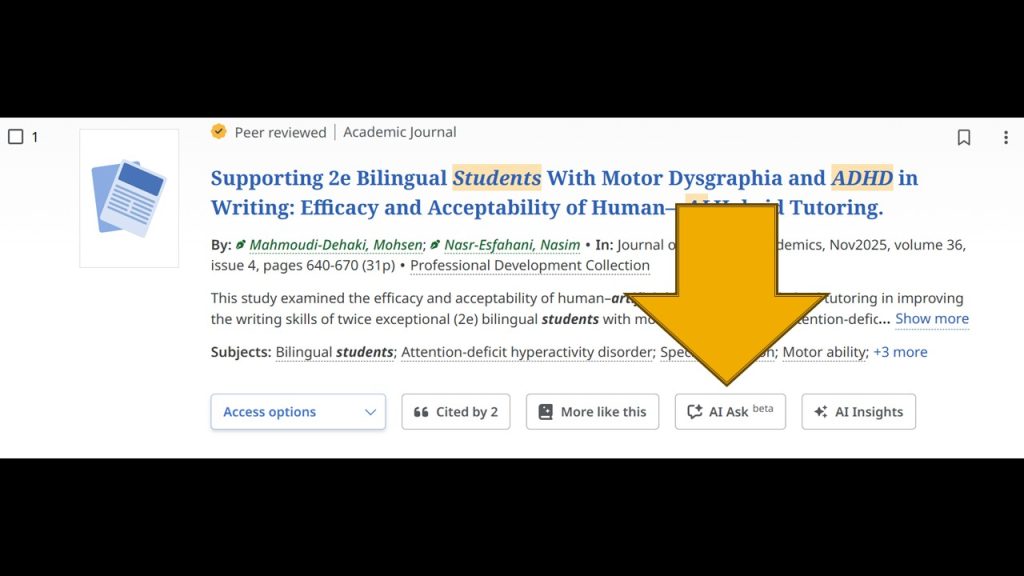
AI Ask tool example as found in EBSCO products
Should I use AI or not?
This is a difficult question since the answer is often subjective. When deciding whether to use AI or not, consider the following AI Use Policy concepts developed by Eric Cross: https://wpvip.edutopia.org/wp-content/uploads/2026/07/AI-Use-Policy_Eric-Cross.pdf
- Your Thinking Comes First: consider if you can do the task on your own instead of depending on AI, is AI allowed for the task, can you explain your process and the concepts in your words.
- AI Use Levels for Each Assignment: recognize that AI may not be allowed for all assignments, so consider if it is allowed for the task.
- What You Can Use AI For: usually, it is acceptable to use AI to help you understand basic ideas, brainstorm ideas, aid you in your inquiry of research questions and investigations, and improve the communication of your ideas. However, your work must be your own.
- What You Cannot Use AI For: to avoid thinking, reading, writing, designing, or explaining. Your final work must be your own, not the AI’s.
- Academic Integrity Means Honesty: be honest in your use of AI, and when allowed to use AI, do not use it to gain an unfair advantage, acknowledge the AI usages, and be responsible for your work.
- Be Honest About AI: Your AI Use Note: clearly document how, what, when, and related aspects of AI use in your work. This may include prompts given to the AI and the outputs used.
- Check AI Like a Scientist: AI outputs are often flawed by misinformation, biases, inaccuracies, and hallucinations. You are responsible for checking the quality of the AI-produced information and, ultimately, your submitted work.
- Respect People, Cultures, and Communities: recognize that AI outputs may not fully represent each group of people involved in the problem you are studying, including related professionals. Consider how others might view the AI output from different perspectives.
- Protect Privacy and Safety: recognize the need to keep personal information private. Whether it is your information or another’s, do not enter personal information into an AI. There are usually privacy rules, property rights, copyrights, and laws governing how information is to be kept private, and you will not want to make violations, particularly since the entered information is not usually retractable.
- What Happens if AI Is Misused?: In an academic or professional setting, you may be asked to explain your work process, use of AI, redo your work, complete assignments under supervision, or receive a failing grade or dismissal notes.